Sparks Off the Anvil: A Week in the Life of America's Last Hand-Forging Blacksmiths
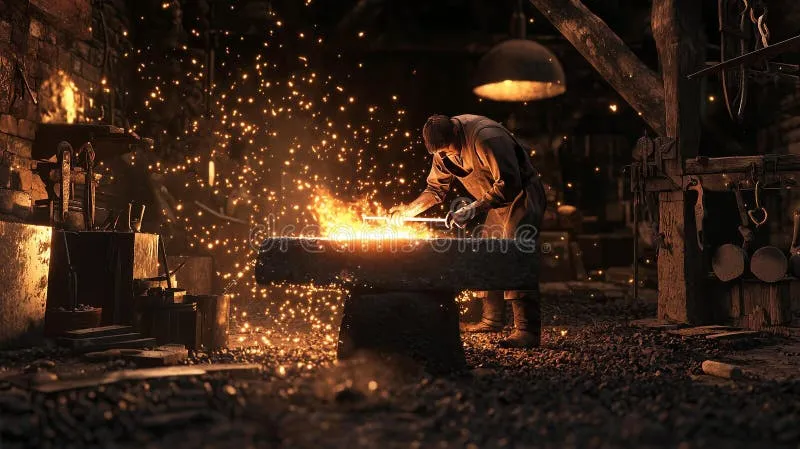
Photo: blacksmith forging knife on anvil sparks rural workshop, via thumbs.dreamstime.com
The first thing you notice in Dale Koontz's shop isn't the heat. It's the sound. A rhythm, steady as a heartbeat, coming off a 200-pound London-pattern anvil that's older than the state of Montana. Tink. Tink-tink. Tink. Every strike lands where he means it to land, which is more than most of us can say about anything we do all day.
I came to this patch of scrubland outside Miles City to answer a simple question: in a country where you can order a machete for eleven bucks and have it on your porch by Thursday, why is anyone still forging steel by hand?
The answer, it turns out, takes a full week to explain.
Monday: Horses First, Always
Dale's week starts at 5:30 a.m. under a horse, not at the anvil. Farriery — shoeing horses — pays the mortgage. The art pays the soul.
By 9 a.m. he's shod two ranch horses and burned through a thermos of black coffee. His hands look like tanned leather gloves with fingers. When I ask about the burn scars, he waves it off. "That's just Tuesday," he says. It's Monday.
There are maybe a few thousand full-time farriers left in America, and far fewer who shoe and forge their own stock. Dale is both. He heats bar steel in a propane forge, draws out the shoe under the hammer, and fits it hot — a practice most modern farriers abandoned decades ago for pre-made keg shoes.
"A hot fit seats better," he shrugs. "The horse knows. The horse always knows."
Wednesday: Heirlooms, Not Inventory
Midweek, the shop shifts from livestock to legacy. On the bench: a chef's knife commissioned by a woman in Bozeman whose grandfather homesteaded the same valley in 1911. She wants it made from a piece of an old crosscut saw blade that belonged to him.
Dale forge-welds a high-carbon edge onto a mild steel body, working the billet at a bright orange heat, flux bubbling like pitch. One bad weld and the whole day's work delaminates on the anvil. He's done it twice in thirty years. He remembers both.
"People ask why my knives cost what they cost," he says, hammering. "I tell 'em: you're not buying a knife. You're buying the last time this thing will ever need to be made."
That's the whole philosophy right there. A stamped import is a purchase. A forged blade is a provision — something you hand down with a story attached.
The Economics of Stubbornness
Let's be honest about the numbers, because Dale is. He clears less than a plumber's apprentice. Insurance for farriers is brutal. His knees are shot, his hearing rings constantly, and the closest thing to a pension is a shed full of tools he'll sell off someday.
So why?
He thinks about it while reheating a hatchet eye. "Convenience is fine until the power's out," he says. "Until the truck breaks down 80 miles from town. Until you need a thing made right and there's nobody left who knows how." He pulls the steel, lays it on the anvil, and starts.
There's a stubborn streak in rural America that doesn't show up in GDP numbers — the conviction that some skills are too important to lose, even if nobody's paying full price for them. Dale's shop is a museum that happens to have a cash box.
Friday: The Kids in the Doorway
Here's the hopeful part. On Friday afternoons, Dale teaches. Not a fancy school — a handful of locals, some teenagers, one retired schoolteacher, all crowded around a second forge made from a salvaged brake drum.
Attendance is up. Way up. The wilderness skills revival that's pulling young people toward flintknapping and friction fire is pulling them toward the forge too. They show up having watched videos, full of enthusiasm and no idea how hot steel actually is. Dale's first lesson is always the same: touch the wrong thing once, and you'll never forget it.
"Half of them quit," he admits. "The other half, though —" he nods at a sixteen-year-old drawing out his first nail, tongue between his teeth, "— that half, they're hooked for life."
What the Anvil Knows
On my last night, Dale finishes the Bozeman knife. He quenches it in oil, tempers it in the kitchen oven next to a casserole, and stamps a small wolf's head into the ricasso — his maker's mark, cut by hand decades ago.
He holds it up to the light and checks the edge the way a jeweler checks a stone.
"My grandfather shod horses in this valley," he says. "Nobody remembers his name. But I've got a hammer of his that still works every single day." He sets the hammer down. "That's the trade. You don't get famous. You make things that don't quit."
Outside, the Montana dark comes down over the shop. Inside, the forge ticks as it cools, and the anvil sits silent until Monday.
Somebody, somewhere, will always need an edge that holds. And as long as that's true, there will be someone stubborn enough to stand over the fire and make it.