One Barge, One Cable, One Shot: The Ferry Captain Who Is the Whole Road
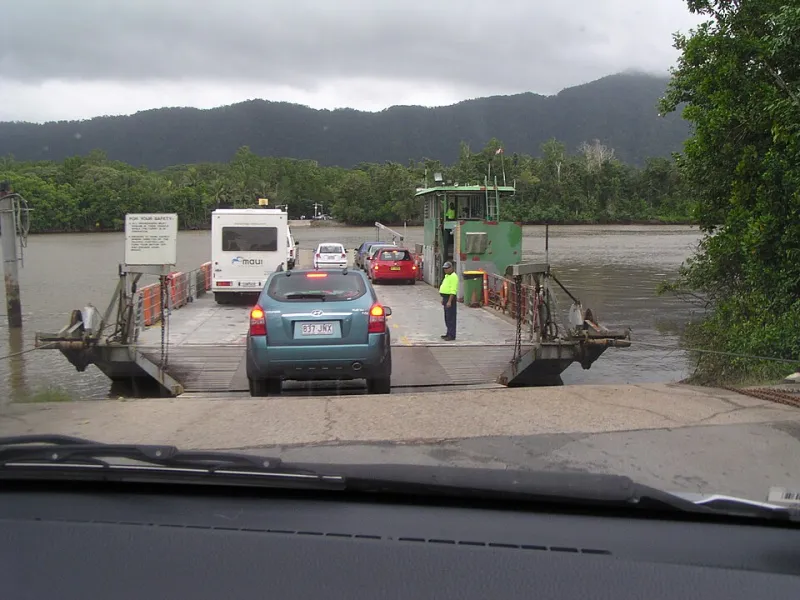
Photo: Mike Young, CC BY 2.5, via Wikimedia Commons
The cable hums before you see it. That's the first thing they don't tell you about a river crossing. You pull up to the bank, gravel crunching under your tires, and there's this low metallic note in the air — a quarter-mile of frayed steel stretched tight across the water, singing in the wind like a guitar string nobody's touching.
That's the road. That's it. That's the whole infrastructure plan.
The Commute Is a Crank
Dale runs the crossing. Has for eleven years. His office is a flat-deck barge maybe forty feet long, rigged to the cable with a system of pulleys and a wheel that looks stolen off a pirate ship. On a good day he cranks it back and forth a dozen times. On a Sunday he might make the trip sixty. School buses, grain trucks, a hearse once, a guy hauling bees — if it needs to get across, Dale is the difference between a two-minute crossing and a ninety-mile detour through the next county.
"People think it's romantic," he told me, leaning on the wheel. "It's a job where you can't be sick. Can't be late. Can't have a bad day. The river doesn't care and neither does the feed store."
There used to be dozens of these ferries up and down the inland rivers. Cable crossings, reaction ferries, the kind that use the current itself to push the barge across at an angle, like a sailboat tacking upstream. Most died when the bridges came. A few hung on — one in Kansas, a couple in the Ozarks, a famous one in Minnesota that's been operating in some form since the 1800s. Each one survives because a bridge would cost millions and a barge, a cable, and one stubborn human cost considerably less.
The Weight of Being the Only Option
Here's what a season out there taught me about dependency: it's quiet. Nobody thanks the bridge. But everybody knows the ferry operator's name, because everybody knows exactly whose hands their day is sitting in.
Dale keeps a mental ledger of the town's rhythm. The mail runs at ten. The vet comes through on Thursdays. If the ambulance is coming from the county seat, he's already cranked to the far bank before the sirens are audible, because he's learned to listen for them the way a farmer reads clouds. He's never once made an emergency wait.
"You get one shot," he said. "Bridge goes down, they fix it in a day. Cable snaps or the captain doesn't show, and this town's an island."
The cable itself is the whole religion. It's inspected, greased, watched. Dale walks its length on the bank anchors every week, running his glove along the strands, feeling for the broken wires that feel like a beard stubble against the steel. A frayed crossing doesn't announce itself. It just gets thinner, quietly, until somebody pays attention or pays the price.
What Happens When the River Freezes
Every operator has the same nightmare, and it's not drowning. It's ice.
When the river starts to freeze, the whole operation becomes a countdown. The barge has to come out of the water before the ice can crush its hull or lock the cable in a vise of frozen current. So there's a window — a few days, sometimes a few hours — when Dale and a couple of neighbors winch the barge up the ramp, disconnect the rigging, and pull the cable's tension loose.
Then the town changes. The detour becomes real: a drive that was ninety seconds becomes an hour and change, each way. People stock up like it's a storm that lasts all winter. The store orders more. The school bus route gets rewritten. And Dale, suddenly without a job to do, gets antsy in a way he doesn't like to admit.
"Winter's when you find out what the crossing means," he said. "Summer, it's convenient. Winter, it's everything."
Come breakup — that chaotic week when the ice groans and shifts and piles up in ridges along the banks — he watches the river like it owes him money. Too early back in the water and a moving sheet of ice can take the barge out entirely. Too late and the town grumbles. Reading that transition is a skill no certification covers. You learn it or you don't.
Why Keep It Running
I asked the obvious question. A bridge. One time. Federal money exists for this. Why crank a wheel in 2025?
Dale shrugged the shrug of a man who's answered it a thousand times. The bridge study alone costs more than a decade of ferry operation. The engineering would change the river's flow, the state would want a road realignment, and the whole thing would take years that nobody out here believes in. The ferry works. It has worked since before anyone alive remembers. It works at a scale a person can understand — hands, steel, current, done.
There's something else, though, and it took me most of the season to name it. The crossing keeps the town honest with itself. Every trip is a small act of participation. You wait your turn. You help the guy with the trailer hook up. You know the operator, and he knows whether your kid made the honor roll. A bridge would be faster and anonymous. The ferry is slower and it's yours.
On my last morning, Dale cranked me across at dawn, mist coming off the water in slow rolls. Halfway over he stopped, both hands on the wheel, and listened to the cable sing.
"Hear that?" he said. "That's the river keeping its end of the deal."
Then he cranked the rest of the way, and the far bank came up out of the fog like it always does — as long as somebody's willing to pull the wheel.