Sparks Before the Storm: Learning to Make Fire the Old Way Before the Grid Fails Again
The first thing nobody tells you about flint and steel is how loud it is. Not the crack of the stone — that's a sharp tick, like a knuckle popping. It's the char cloth catching. A whisper of orange crawls across the fabric, and suddenly you're holding a live coal in your bare hand in the middle of a frozen November morning, and your brain lights up in a way a butane lighter has never managed.
That's the hook instructors are betting on. Across the country, from Minnesota to the Carolinas, bushcraft schools are reporting their biggest winter enrollments ever. The reason isn't hard to figure out. Every ice storm that takes out a grid for a week makes a few thousand people realize they own exactly zero ways to make fire without a switch on the wall.
Why This Skill Refuses to Die
Flint and steel is older than America itself, and it crossed the continent in every fur trader's pack. Before matches were cheap and reliable, a striker was a personal possession — carried for decades, worn smooth by a thumb, worth more than its weight in a snowstorm. Mountain men traded whole pelts for good steel.
Then the friction match showed up in the mid-1800s and killed the striker's reign inside a generation. Convenient beats effective almost every time. But convenient has a failure mode: no fuel, no fire. A striker and a rock work wet, work cold, work after the lighter in your jacket pocket has been through the wash twice.
"I tell students the same thing every class," says one instructor I watched teach a group of twelve outside Bozeman. "You're not learning this because you'll use it every day. You're learning it because the one day you need it, nothing else is on the table."
The Gear: Less Than You Think
Here's the beautiful part. The whole kit fits in an Altoids tin.
- A high-carbon steel striker. Not stainless — it won't throw sparks worth a damn. Old files, repurposed, are a classic. Twenty bucks buys a hand-forged one.
- A rock that's harder than the steel. True flint if you can get it, but chert, quartzite, even a broken chunk of some agates will do. If it sparks against the steel or cuts glass, you're in business.
- Char cloth. Cotton fabric cooked in a low-oxygen fire until it's black and feather-light. It catches a spark and holds it like an ember.
- A tin to make more char cloth. The cycle keeps itself going.
- Tinder beyond the cloth. Jute twine pulled apart, dry grass, cedar bark shredded fine. The coal is the baby; this is the food.
Total damage: under $50 if you buy everything, close to free if you scrounge. Compare that to the price of a generator, or a motel room when the heat's out.
The Technique, Stripped Down
The motion is a downward scrape, not a strike. Hold the flint still, sharp edge up, and drag the steel's spine down and across it like you're sharpening a knife. Sparks fly off onto the char cloth held against the top edge — or on the ground below, if you set it up that way.
- Prep first. Have your tinder bundle fluffed and waiting. Fumbling with dry grass while a coal dies is the beginner's classic.
- Catch the spark. Hold the char cloth over the edge and scrape. It might take ten tries. That's normal.
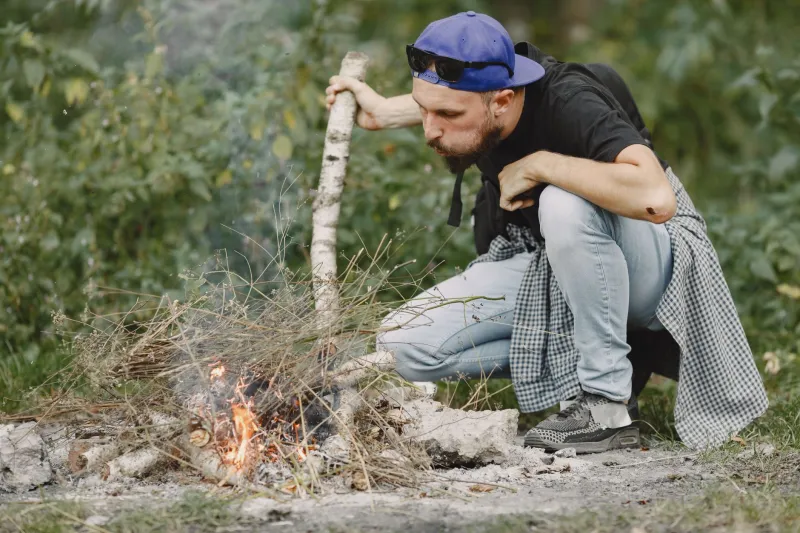
- Transfer and nurse. Once the cloth glows, fold it into your tinder nest and blow — long, steady breaths from below, not short panicked puffs. Smoke first, then flame.
- Feed it small. Pencil-lead-sized twigs before anything bigger. Impatience is the number one fire killer.
My first success took forty minutes and both my thumbs. My fourth took ninety seconds. That learning curve is exactly why people get hooked — it's a skill, not a product.
The Winter Argument
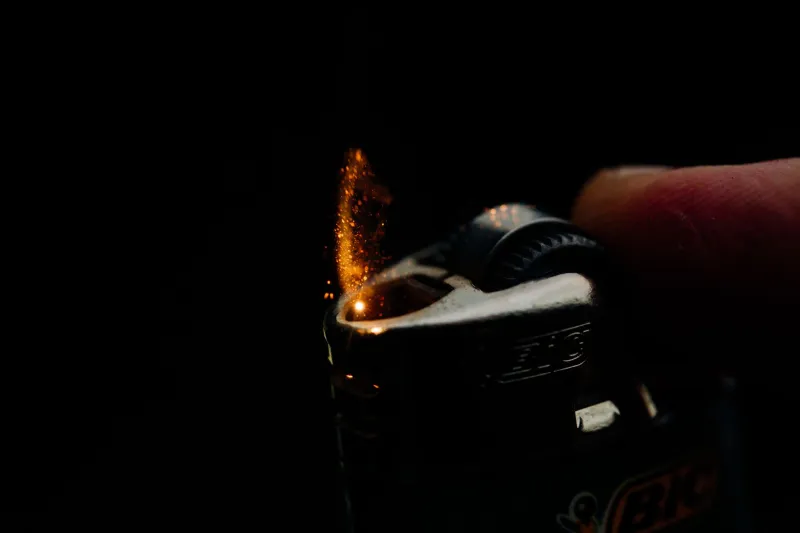
Nobody's saying toss the Bic. Carry the Bic. But a lighter fails in ways you can't fix: no fuel, cracked wheel, cold-stiffened thumb. A striker fails in exactly one way — bad technique — and technique is fixable.
There's also something the gear lists can't capture. Strike a spark, catch it, blow it to flame, and you've done something your great-grandfather did ten thousand times. The grid hums along, and mostly we don't think about it. But the wires are older than we pretend, the storms are meaner, and the gap between comfortable and cold is one ice storm wide.
Learn to strike stone. Hope you never have to.