Where the Map Runs Out: Five American Ghost Towns the Wild Is Taking Back
Ghost towns get photographed like movie sets, all sun-bleached wood and long shadows. But spend real time in one and you notice something else: they're not frozen. They're being digested. Roofs cave, foundations sprout sagebrush, and the animals that never left come down out of the hills to reclaim streets that were only ever borrowed from them.
The Long Game, in other words, is being played by the landscape — and it's winning. Here are five places where you can watch it happen.
1. Rhyolite, Nevada
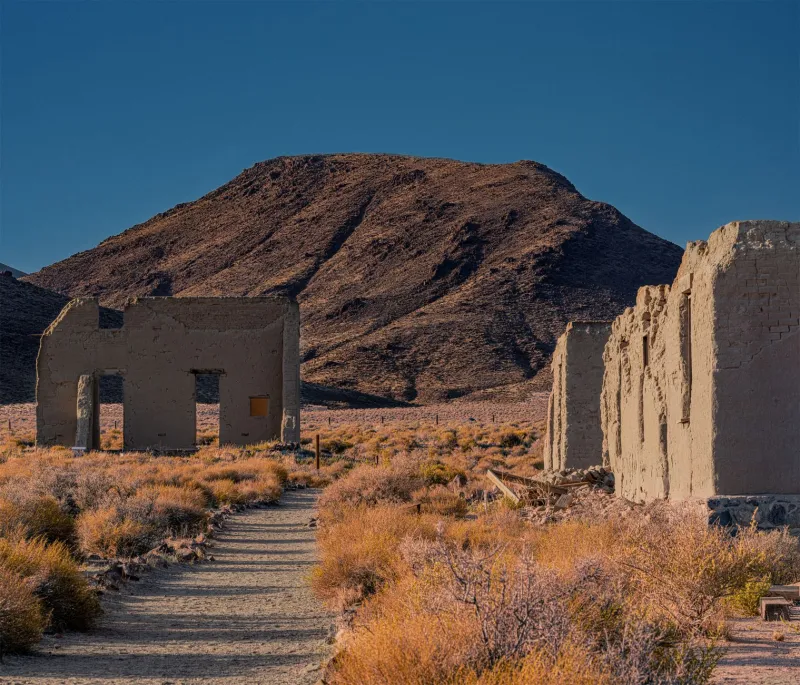
The classic, and for good reason. Rhyolite boomed to maybe 5,000 people after 1904 gold strikes, built a three-story bank and an opera house, and was functionally dead by 1916. Today the Cook Bank Building's arched shell stands against the Bullfrog Hills while a volunteer-maintained open-air art installation creaks at the edge of town.
The wild's progress: Kit foxes den in the culverts. Ravens own the rooftops. The famous bottle house is slowly shedding its mortar into the sand.
Go now because: It's the most accessible on this list — paved road off Highway 374 near Beatty, an easy day trip from Death Valley. Sunrise light on the bank ruins is the shot.
2. Bannack, Montana
Montana's first territorial capital, now a state park, and proof that a ghost town can be preserved and still wild. Sixty-odd structures line a single dusty street beside Grasshopper Creek, where the 1862 gold strike started everything.
The wild's progress: Elk herds winter in the valley below town. Swallows nest in the hotel's eaves. On quiet October mornings, the only sound is Grasshopper Creek doing exactly what it did before anyone found gold in it.
Go now because: Montana winters eventually close the road. Late September, after the summer crowds thin, is the window.
3. Cairo, Illinois
Different flavor entirely. Cairo was a river city — steamboats, railroads, a grand downtown at the meeting of the Mississippi and Ohio. Discrimination, floods, and the highway system bled it dry, and whole blocks of brick storefronts now stand empty behind chain-link.
The wild's progress: In a town, "wild" looks different. Vegetation bursts through warehouse roofs. Vultures roost on the old grand hotel. The bottomland forests around the confluence — now a state park — are thick with deer and wild turkey.
Go now because: This one is disappearing faster than the desert towns. Buildings that were standing five years ago aren't.
4. Bodie, California
Yes, it's famous. It's still worth the dirt road. Bodie is a California State Historic Park kept in a state of "arrested decay" — 170-odd buildings left exactly as their last residents abandoned them, groceries still on shelves in the store.
The wild's progress: At 8,375 feet, the Sierra winter is the landlord here. Snow crushes a porch or a roof nearly every year; the park's crew stabilizes, the weather erodes. Marmots and pikas live in the talus above town. The ponderosas are creeping back down Main Street's margins.
Go now because: It's the best-preserved town on this list, and preservation is a slow surrender. Summer for access, but a winter snowshoe trip (ranger-guided) is the experience of a lifetime.
5. Table Rock and the Empty Quarter, Nebraska
Not one town — a pattern. Drive the highways north of the Platte and you'll pass graded streets, a few foundations, a lone cottonwood marking where a church stood. The Dust Bowl and the tractor emptied hundreds of these Plains hamlets, and the shortgrass took everything back.
The wild's progress: Complete. Pronghorn graze where main streets ran. Burrowing owls occupy prairie dog towns that never heard of a homestead. This is rewilding at a scale no nonprofit could engineer.
Go now because: "Now" is the wrong word — it's been going on for ninety years and will continue. Go for the silence. Bring fuel, water, and no expectations of cell service.
Read the Ruins Right
A few ground rules from people who visit these places for a living:
- Take only photos, and take them from the doorways. Floors in abandoned buildings are trapdoors over cellars and shafts, especially in mining towns.
- Check land status. Half the ghost towns on any map sit on private or tribal land. BLM and state park listings are your friends.
- Go in shoulder season. Fewer people, better light, and the animals are moving.
- Never enter structures marked unsafe — and treat all of them as marked.
Every one of these towns is a negotiation between what people built and what the land intends to keep. The land has more time than we do. Visit while the argument is still visible.