What the Junkyard Knows: The Makers Who Build Beauty Out of What America Threw Away
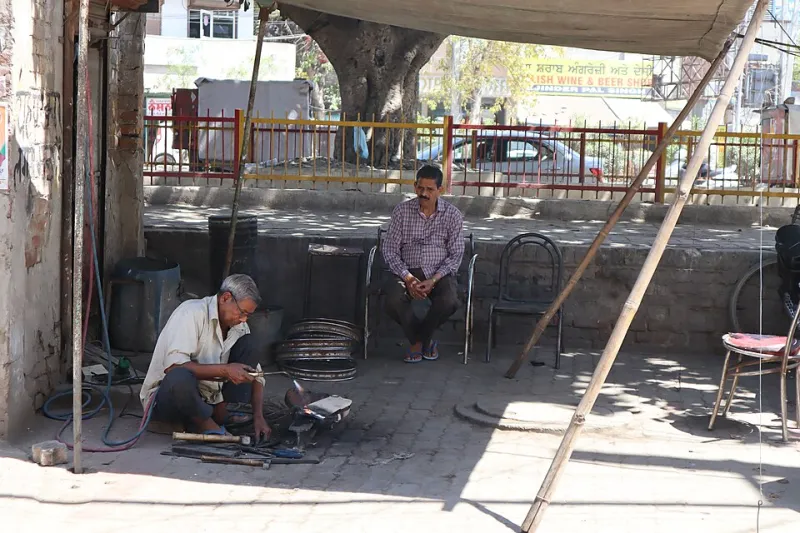
Photo: MaplesyrupSushi, CC BY-SA 4.0, via Wikimedia Commons
There's a moment in every salvage yard when the pile stops being junk. It usually happens quiet — no announcement, no lightning bolt. You're walking past a rusted-out Chevy bed or a stack of barn beams gone silver with weather, and then your eye catches something: a curve in the steel, a nail hole in the wood, a story the metal hasn't finished telling.
The makers in this story live in that moment. They're welders and bladesmiths and furniture builders scattered across the rural map — Montana, Kentucky, the Texas Hill Country — and they share one stubborn conviction: nothing that was built well should die stupid.
The Truck That Became Forty Knives
Dale Marchetti's shop sits at the end of a gravel road outside Bozeman, and the first thing you notice is what's not there — no new stock, no shiny bar stock in racks. Instead there's leaf springs, saw blades, an old plow share leaning against the wall like a retired workhorse waiting for one more season.
"People think I'm romantic about it," Dale says, striking an arc on a coal forge he built from a brake drum. "I'm not. I'm cheap, and old steel is better steel. That leaf spring? It's been through heat before. It knows the drill."
His claim holds up metallurgically. High-carbon steel from vintage truck springs and sawmill blades often outperforms some modern commercial stock, and bladesmiths have known it for generations. But the economics are the real story. Dale clears a modest living — he won't say exactly how much — selling hand-forged knives at regional craft fairs and through a waitlist that runs eight months deep. His material costs are close to zero. His overhead is a woodstove and stubbornness.
"The junkyard is my lumberyard," he shrugs. "Nobody's competing with me for it."
Barn Beams and the Architecture of Patience
Fourteen hundred miles southeast, in Kentucky's Eden Shale hills, Ruth Calloway runs a different kind of operation. Her salvage is wood — hand-hewn barn beams, wormy chestnut, wide-board oak flooring pulled from farmhouses that lost their roofs to storms or economics.
She and her husband dismantled their first barn in 2011, mostly to help a neighbor who couldn't afford the demolition. They sold the beams and realized the market was real. Today her furniture — long farm tables, mantels, shelving with the saw marks left raw — sells to buyers in Louisville, Nashville, and increasingly, coastal cities where "reclaimed" carries a premium.
"The wood is denser than anything you can buy now," Ruth says, running a hand along a beam that still shows the broad axe marks from some long-dead carpenter. "Old-growth growth rings are tight. That tree stood a hundred and fifty years before anybody cut it. You don't get that from a tree farm."
The work is brutal, though, and she's honest about it. De-nailing a barn's worth of timber wrecks blades, backs, and occasionally friendships. Hidden metal in old beams is a table-saw's nightmare. Her insurance costs more than her materials. "People see the finished table and think heritage, craftsmanship," she laughs. "I see six weekends pulling nails with a cat's paw."
Scrap Steel With Something to Say
The third stop is the strangest. Outside Marfa, Texas — a town already famous for art in odd places — welder-turned-sculptor Tomas Reyes builds life-sized animals from scrap: coyotes from lawnmower hoods, a heron from rebar and a washing machine drum, a wolf from what he swears is the hood of a 1972 F-100.
"The wolf took the longest," he says, walking us around the ten-foot piece in his side yard. "Not because it was hard. Because I kept finding parts that were almost right. You can't force scrap. You have to wait for the piece that was always meant to be that rib, that hip."
Reyes sells mostly through commissions now, and his pieces dot ranch gates and gallery lawns across West Texas. But he bristles at the word "upcycling," which he considers a Whole Foods word. "I'm not saving the planet. I'm just a guy who hates seeing good steel rust in a ditch."
The Real Economy of Junk
Here's the part the Instagram posts don't show. Making a living from salvage is a grind of hauling, torch-cutting, tetanus shots, and the slow education of learning what a piece of metal is worth versus what it costs you in time. Fuel for the truck to the yard. Grinder discs. The customer who wants a "rustic" table but not, apparently, actual rust.
The makers who survive tend to share three traits. They price their time honestly, even when it stings. They develop a repeatable product — the knife, the table, the gate — rather than chasing every whim. And they tell the story of the material, because the story is often the only thing separating their work from something cheaper at a big-box store.
"Every piece I sell comes with where it came from," Dale says, wiping down a blade he forged from a crosscut saw. "That saw cut timber for sixty years before it made this knife. You're not buying a knife. You're buying a second life."
What Broken Things Understand
There's a reason this ethos resonates right now, in a country drowning in disposable everything and algorithmic sameness. Salvage work is the opposite of the feed. It's slow, local, physical, and it carries the fingerprints of two eras — the one that made the material and the one that remade it.
The wolf survives by what it can find. The flint edge comes from striking what's already there against what's already there. The makers in these workshops — Dale's forge smoke, Ruth's nail-scarred hands, Tomas's waiting piles of steel — are doing the same thing with different materials.
Taking what the world gave up on. And giving it an edge.